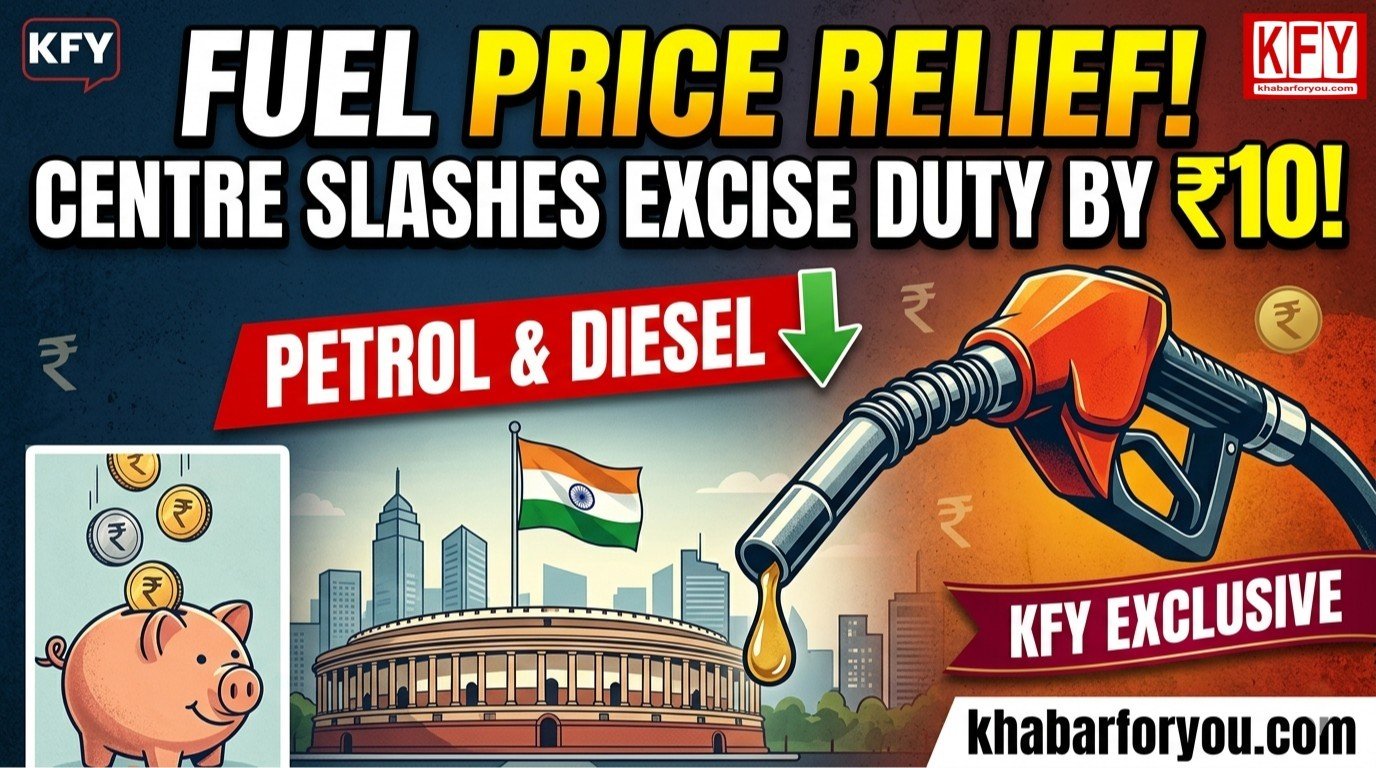
Fuel Price Relief: Centre Slashes Petrol & Diesel Excise Duty by ₹10 | KFY Exclusive
- Khabar Editor
- 27 Mar, 2026
- 97737
Email:-infokhabarforyou@gmail.com
Instagram:-@khabar_for_you


In a high-stakes fiscal maneuver aimed at insulating the domestic economy from a volatile Middle East conflict, the Central Government late Thursday issued a landmark notification slashing excise duties on petroleum products. The move, characterized by top analysts as a "strategic shock absorber," effectively reduces the tax burden on petrol and diesel by ₹10 per litre, bringing the additional excise duty on diesel to a historic nil.
As the global Brent crude benchmark breached the $120 per barrel mark following the escalation of the Iran-Israel conflict and the subsequent chokepoints in the Strait of Hormuz, the Narendra Modi-led administration moved to preempt a domestic inflationary spiral. While the ₹10 and ₹13 figures dominated headlines, an investigative lens reveals a complex interplay between state-run Oil Marketing Companies (OMCs), global supply chain disruptions, and the government’s delicate balancing act with the fiscal deficit.
Read More - US Naval Armada Prepares for April 6: Trump’s Final Ultimatum to Iran | KhabarForYou
The Fiscal Math: A ₹1.75 Lakh Crore Gamble
The Ministry of Finance’s notification (No. 11/2026-Central Excise) is not merely a populist gesture but a massive financial intervention. The annual impact of these cuts is estimated at ₹1.75 lakh crore in lost revenue for the exchequer.
Previously, the excise duty on petrol stood at ₹13 per litre, which has now been curtailed to ₹3 per litre**. In an even more aggressive move, the ₹10 duty on diesel has been completely eliminated. This "Zero-Duty" regime for diesel is particularly significant; as the primary fuel for the logistics and agricultural sectors, any price hike here has a "cascading effect" on the cost of essential vegetables, grains, and FMCG goods.
The "Hidden" Relief: Why Pump Prices Remain Static
Despite the massive tax cut, citizens reaching petrol pumps in cities like Bikaner, New Delhi, and Mumbai this morning found retail prices largely unchanged. This discrepancy has sparked intense debate.
An investigation into the balance sheets of OMCs - including IOCL, BPCL, and HPCL - shows they were incurring "under-recoveries" (losses) of approximately ₹48 per litre due to the 50% surge in global crude prices since February.
"The excise duty cut is not a price reduction for the consumer yet; it is a lifeline for the OMCs," says a senior energy analyst. "Without this ₹10 buffer, the companies would have been forced to hike retail prices by at least ₹25 per litre to stay afloat. The government has essentially chosen to take the hit on its own treasury to prevent a price shock at the pumps."
Geopolitical Undercurrents: The West Asia Crisis
The timing of this "Badi Rahat" (Big Relief) is inextricably linked to the 27th day of the West Asia crisis. With the Strait of Hormuz effectively inaccessible to many tankers, India’s 88% dependency on oil imports has become a critical vulnerability.
While private retailers had already begun raising prices by ₹3 to ₹5 per litre earlier this week, the Central Government’s intervention has effectively "frozen" the market. Union Petroleum Minister Hardeep Singh Puri clarified that while nations in Europe have seen 30% hikes in fuel costs, India remains strategically insulated.
Regional Impact: The Rajasthan Perspective
In the desert circuits of Rajasthan, particularly in the border district of Bikaner, the high VAT (Value Added Tax) historically makes fuel more expensive than in neighboring Punjab.
While the Centre has done its part, the ball is now in the court of State Governments. If Rajasthan follows the Centre’s lead with a proportionate VAT cut, the actual retail price of petrol in Bikaner could drop below the ₹100 mark for the first time in months. Currently, petrol in the region hovers around ₹104-₹106, depending on local logistics.
Beyond Fuel: The RELIEF Scheme for MSMEs
The government's intervention extends beyond the petrol pump. Simultaneously, the Ministry of Commerce has rolled out the ₹497 crore RELIEF (Resilience & Logistics Intervention for Export Facilitation) scheme.
A significant portion - ₹282 crore - is earmarked specifically for MSME exporters. For small-scale industries in Rajasthan exporting handicrafts and textiles, this provides up to 95% insurance coverage for shipments stranded by the maritime blockade. It is a dual-pronged strategy: keep the domestic cost of living stable via fuel subsidies and keep the export engine running via credit guarantees.
Conclusion: The Road Ahead
The ₹10 relief is a masterstroke of crisis management, but its longevity depends entirely on the duration of the conflict. Should global crude stay above $120 for more than a quarter, the government may find it impossible to sustain a "Zero-Duty" regime.
For now, the message is clear: The "Big Relief" has arrived not as a discount, but as a shield. The government has spent its fiscal bullets to ensure that the fire in West Asia does not burn the pockets of the common Indian citizen.
Business, Sports, Lifestyle ,Politics ,Entertainment ,Technology ,National ,World ,Travel ,Editorial and Article में सबसे बड़ी समाचार कहानियों के शीर्ष पर बने रहने के लिए, हमारे subscriber-to-our-newsletter khabarforyou.com पर बॉटम लाइन पर साइन अप करें। |
| यदि आपके या आपके किसी जानने वाले के पास प्रकाशित करने के लिए कोई समाचार है, तो इस हेल्पलाइन पर कॉल करें या व्हाट्सअप करें: 8502024040 |
#KFY #KFYNEWS #KHABARFORYOU #WORLDNEWS
नवीनतम PODCAST सुनें, केवल The FM Yours पर
Click for more trending Khabar
Leave a Reply
Your email address will not be published. Required fields are marked *
Search
Category